

What is Residence Time Distribution?
The residence time distribution (RTD) is the probability of how long stream elements remain inside a continuous process. Chemical engineers use RTDs to characterize mixing and flow behaviors. The results are compared with ideal behaviors and used for designing and troubleshooting.
The Theory of RTD
Engineers like to simplify real processes with ideal models. Ideal models have either perfect mixing or equivalent time spans inside the processing equipment.
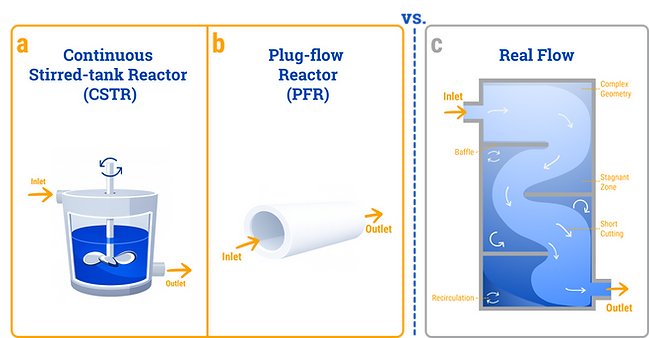
Real processes have imperfect mixing, dead zones, and shortcuts within the equipment, making them difficult to describe.
RTD in Practice
An easy-to-perform experiment can be conducted to gain insights into the flow behavior of a real process. A color tracer is applied at the inlet at time zero (t=0). The response is recorded at the outlet. The shape of the response is the residence time distribution.

The Importance of Residence Time Distribution in Continuous Processing
Mixing, Content Uniformity (CU), and degradation are important terms in continuous processing. All are linked to the RTD, and all processes have their own characteristics. RTD measurements are contributing to deep process understanding and well-defined design spaces.
Risks in Continuous Processing
CU problems cause high costs and can be very difficult to identify. Good mixing is required to obtain good CU and ensure that every tablet contains the required ingredients. Excessive mixing might cause temperature-induced degradation.

Identifying Problems with RTD Measurement
RTD measurements can be performed either on single-unit operations (UO) or on several combined UOs up to complete processing lines. Problems can be studied where they occur.

Problems can be caused by the fluctuation of a feeder, which was not dampened out by the mixing capabilities of the subsequent steps. A newly formed bypass stream prevented good mixing or degradation occurred due to extensive recirculation.
What is ExtruVis Used For?
Continuous processes are applied in almost every industry to manufacture or process materials without interruption. It works on all scales, with small lab and large production equipment. Comparable RTDs ensure successful scale-up. Below are applications that were published by our customers.
Granulation
The screw design can dampen feeding fluctuations as long as they are clearly smaller than the width of the RTD. Feeding units can cause problems.

Out-of-spec granules can occur when one substance is not fed at the appropriate rate for several seconds.
Extrusion
Simulations are widely applied to design hot melt extrusion processes in-silico. Many assumptions have to be made, and most material characteristics are unknown in the early stages.

Validation experiments are performed to check if the assumptions were correct, and the simulation data is reliable.
Continuous Blending
Blenders are often fed by dosing units that discharge the material in a pulsating way, e.g., an auger screw.

The continuous blender must compensate for the pulsation to ensure homogeneous results. A wide RTD is beneficial to smooth out deviations.
Roller Compaction & Milling
Dry granulation consists of unit operations, roller compaction, and milling. Mangal investigated the milling step via RTDs. It was found that a conical mill had shorter residence times compared to an oscillating mill.
